Lake Houses
Creative non-fiction in Ropes Journal #33, April 2025.
Performed at Cúirt International Festival of Literature 2025.
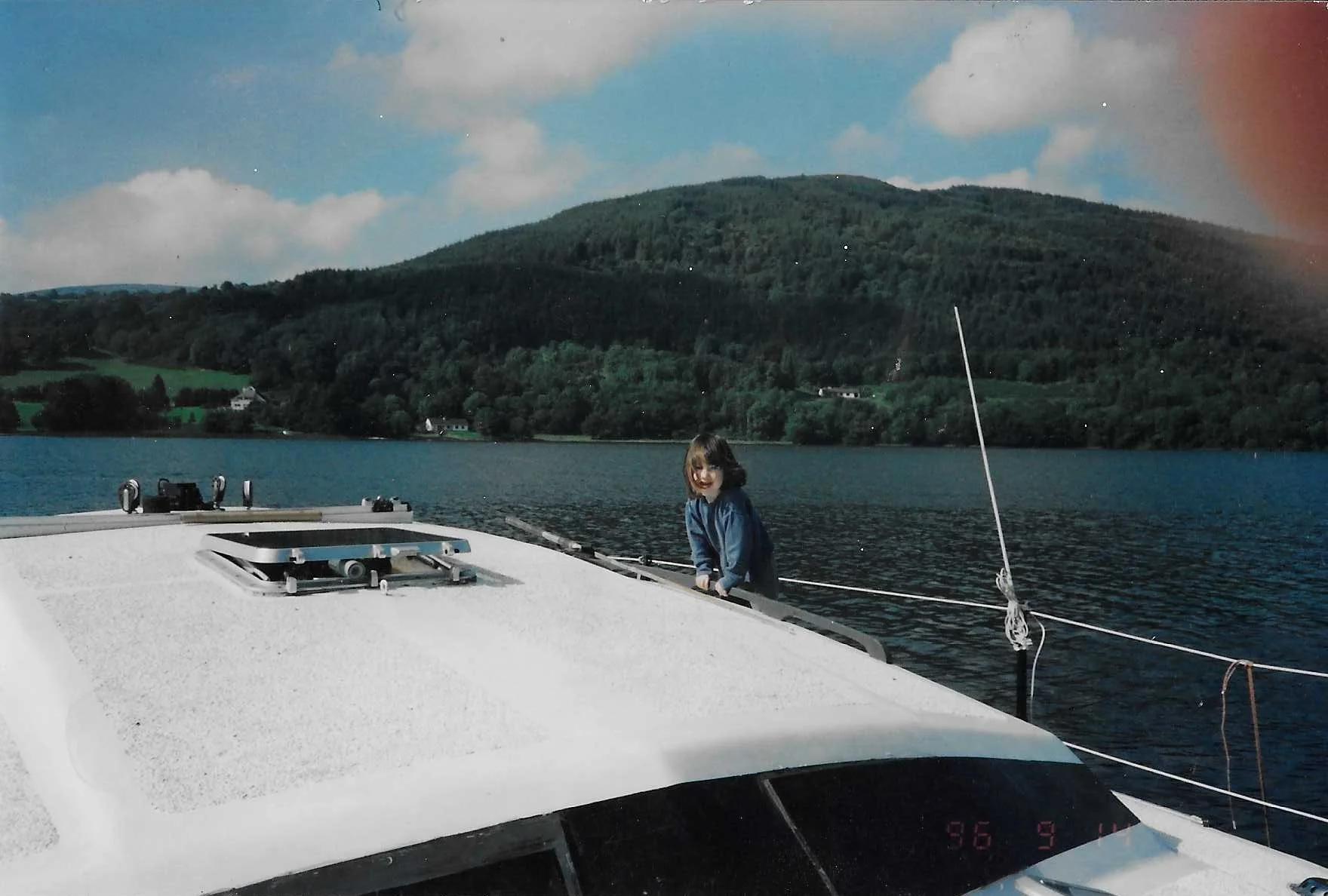
‘I haven’t been back here in fifteen years. We stopped coming when we got the house. We hadn’t time for anything else.’
There’s reminiscence in Mam’s words and in her cigarette clouds, floating around us on the open balcony. It’s the same story she always serves cold. She drinks the last of her Americano with three heaped sugars. Her hangover seems to pass sooner than usual in her eagerness to revisit the place she raised me.
‘Life was so much simpler on the boat.’
She’s at it again.
She’s never been able to accept her decisions. Maybe that’s why it’s taken her so long to come back. We over look the new exclusive boatyard from the new house hotel we drink from. Both are erosions of the shoreline to make way for wealthier tourists and boat hobbyists. Lough Derg, the lake we used to call home has become unrecognisable.
We set off toward the two towns of Killaloe and Ballina, connected by the 18th century thirteen arch bridge over the River Shannon. Locals sometimes argue over the areas overarching name, two tiny towns which make up one. For us, it would always be Killaloe. It wasn’t even Killaloe that held the marina our boat was docked in. That my middle name was chosen after, simply Marina. All the more proof to the locals that we weren’t from there and wouldn’t abide by roadmaps or border names or tradition.
The rain comes in fast from the snow tipped mountain in the distance. As I pull out my umbrella to shield us, she shies away. No rain or pride can stop her today. I remember the towns layout better than her. She rarely lets herself revisit any kind of nostalgia but this place informed my most formative memories. We moved home at least six more times after leaving Killaloe. Each time with a hope that the next would be our permanent home, but when you grow up in transit; you can’t suddenly force yourself to feel at home by sitting still in a four walled house. So, I think of these moves more often than I admit.
Her eyes search, looking for the library, the doctors, the supermarket, the pub she rarely could afford to enjoy. We walk up the hill and I search for Jimmy Whelan’s news-agent. His shop, albeit small, had everything I could ever want as a child and it’s the only time I remember seeing sweets or holiday toys for tourists. He probably took pity on us and charged us less. As I pass the empty shell of his shop – a place I know he wouldn’t have left without great fuss – I wish him well. We walk silently past the cordoned off Cathedral Mam wanted to stop by to show me the inside of. I can see in her shoulders she didn’t expect such losses. Everything we remember is closed or replaced by brunch cafés or boutiques. We let the rain pelt us dutifully, creating tears in the crease of our high cheeks.
We cross the bridge and stop in one its pedestrian nooks. The trucks on the road have to yield to the oncoming cars but it’s not as scary as it was when I was young. There’s no sight of hire boats or fishermen angling below the bridge or even brave teenagers jumping into the deep water off the jetties ahead. I look down the river towards Limerick city to see cranes and construction across the river’s width. I understand immediately what they’re building. A bypass. A way to skip past these towns altogether. A huge alteration to the river but a minor adjustment to commuters’ time. This river will finally be tamed. Mam pretends not to care and points over to the right canal and adjoining lock.
‘I used to row you up to playschool and leave the dingy tied up here.’
She’s told me this so many times before. We have photographs of us, life jacket-less, waving as we head off for the education she fought for against my father’s indifference. She rowed the whole way up and down the river four times a day. I remember plastic bags of fruit and ravioli tins rolling along the fiberglass floor. She relished it, just the two of us conquering the tide together and excelling at her only job; being my mother. I liked going to playschool and meeting other children but I preferred home-time, to rush back, to read a new storybook to my dog Purdy in the boat’s open cockpit. She was a stray cross-bred collie; we found her wandering the boatyard and she soon became my first best friend.
We walk toward our marina, inspecting the only four homes along the big stretch of road. Mam stops at the façade of the first home to inspect its architecture is still intact, it is, and it was part of the original railways. Such a stark contrast to the next three modernist lake houses, jutting out over their intercom gates. The lake view is completely impenetrable from the road. It’s for their eyes only. We used to peer in through the gate cracks, wondering what it must be like having the best of both worlds, a home and the lake, side by side. Now instead, we speculate their market value, considering their lakeshore frontage is such a rare privilege.
We arrive at the refurbished Lakeshore Hotel. The over saturated chlorine smell emanating from the building is humbly still the same, chemically cheapening its grandiosity. The housing estate angled across from the hotel was in the works when we still lived here. I used to wish I could live there when there were finished. Not many parents allowed their children to play with the only kid in the marina for more than a sparkling Summer. The friends I did make were fickle and fleeting. I’d pray they’d return again for one last day whilst watching their abandoned boats fall into disrepair. Now, the houses look smaller, inconveniently over-crowded on their hill, fighting for their view. It’s a scene of compromise. Wealthy enough to afford a lake view but outside the budget to own a boat below for purely leisure. The types that won't dip their toes into the lake at all.
To our disappointment the marina is closed, privatised by code access only, CCTV to curb us. There are gaping gaps in the community of lonely boats. It shockingly shrinks my memory map of the marina. Where do the tourists go? If there's any left. I would eagerly await the nomads that marveled at the wide berth of our black and white catamaran, against the flimsy 3 sail boats on sunny days. Everyone used to be welcome to taste the fresh freedom of the marina for an evening.
Those poor people wish they could live like us, my father used to say.
It took me many years to realise, we were in fact the poor people and that pride was all he had at his disposal. Lough Derg Marina used to be a welcoming place. There were flags from all over the world clanging off the masts, full of hippies clinging onto their alternative lifestyles, their cabin doors always open for a chat. People would barter goods and services and help one another out at a shout. You didn't need to tick any boxes to live here. And once the marina went bankrupt in the recession, you could even stop paying the mooring fees. NAMA came knocking soon after. The rotting boardwalks and unsafe conditions were one of the reasons we didn’t visit again and we left long before because Mam demanded a proper primary schooling for me. Most importantly was her dream of a spot on the council housing list in Galway city.
If her sister got one, so could she. She knew no council houses would be built here anymore. She was right, if we didn't leave, Killaloe would have pushed us out. My father, fearing stagnancy ashore, stayed behind a lot longer. Purdy was let go to wander Killaloe without me and I was told in a tactless tone that she simply ran away when my father returned. There’s no place for wild things in houses. If only my Mam knew sooner, this was true of my father too.
We sit in the Lakeside restaurant browsing the menu; we are tired. I've never sat in the hotel and I’ve never seen the lake from this angle. It’s almost insignificant as we peer over it. The wide glass windows act as nothing but a beautiful backdrop for an overpriced meal. You'd never see the seaplane land from here or wave to the wide eye Americans on the open top river cruise or catch otters playing underneath the boardwalks. We have come to this hotel together for shelter from the rain and to acknowledge that visiting this restaurant is now a part of our lifestyle. It’s easy. What a different life we live. We review the decadent Morris curtains, commenting on the functionality of them, clearly just for show. I wonder what our boat would’ve looked like with miniature chubby curtains like these if Mam could’ve afforded such fabrics or trims. I am a culmination of changing emotions, empathising with my mother and myself, putting one above the other every few minutes.
‘I only came here once. Just to the functions basement for one of his AA conventions. I didn’t even eat,’ she scoffs as if that’s funny.
I am disappointed in the same solidly boned building that peered over our boat; we were just a prop in its panorama. It’s the same building Mam wished she could afford to bring her daughter swimming in or to join its daycare or to eat lunch in, like the woman with three kids she’s staring at. She had to walk past it to get into town as a daily reminder of how penniless she was and how undeserving she felt of dining here. I sit forward and lean over the table, eclipsing everyone around us. I hold up my bank card in my hand. Only we are in on the secret that we weren’t born to belong here. We have dupped them all and all those years, the hotel had dupped us too. It’s a farcical place with fake curtains and fucking terrible food.
‘Can you imagine? It only took you twenty years to afford a dinner here.’
I land a smirk down at the plates. In tandem we fall back into our velvet tub chairs cackling because this statement seems suddenly ridiculous to admit. What a different life she had in Killaloe compared to the young mother Mam is still staring at.
‘You’re getting me dessert too,’ she takes the menu, savoring her investment in me.
What she won’t admit is… she hates this view, she barely glances at it. She still feels uncomfortable and undeserving. Although she can afford a dinner here, even a weekend away, she could never afford to live in this town anymore. Not even on a boat. It’s nothing like the place that allowed her to raise her daughter on her terms; like a single mother. To live on a boat, that she built from scratch, residing in a marina so cheap that she didn’t have to work. She didn’t have to think, she didn’t have to worry about all the things normal people would naturally worry about, like raising a baby on a boat. She could instead spend all of her time daydreaming with her daughter, the best thing she exclaims to have ever built. That’s why she really wanted to visit, rather, revisit this feeling — with me.
A town where people didn't question her Essex accent. Whether it’s the right or wrong thing to do to. They didn’t ask if she had to forge the address on my birth certificate to avoid a call from social services. We were just… the boat people, leave them be. How could the locals disapprove when we were the people at one with lake living? For us to live on the lake, was the most natural thing in the world. Tourists came and went, making us feel even more rooted to the reeds, a life others couldn’t even dream of living, never brave enough to think beyond a house.
We were living our dream. Supposedly swaddled by the lulling waves, I always slept like a baby and rarely ever cried as a child. Through photographs, retellings and memories, it seems the choice to live on this lake was held on by nothing but the boat’s ropes tied around low deck cleats. Somehow, merely mooring was more than strong enough to build the beautiful life my mother yearned for then and even now wished for again.
Killaloe was the place people visited, photographed the view and dreamt of a piece of their own permanence. The lake had a hold of us, in a state of limerence. Some lucky few have bought glimpses of the lake, thus changing the view forever, leaving behind just our memories. Swimsuits, cygnets, seaplanes, rowboat races, speedboat waves, phony fishing nets, water-damaged photographs.
A place that was always in transition has since stopped flowing in perfect poised stagnation. As we drive home to Galway, we are silenced, we don’t say it. I don’t think we’ll ever return. There's nothing left to see but lake houses.